
Communication Tool for Youth: The Agreement Process

Navigating adult conversations can feel overwhelming, especially if you are a foster youth who often feels like your personal agency and ideas are being talked over.
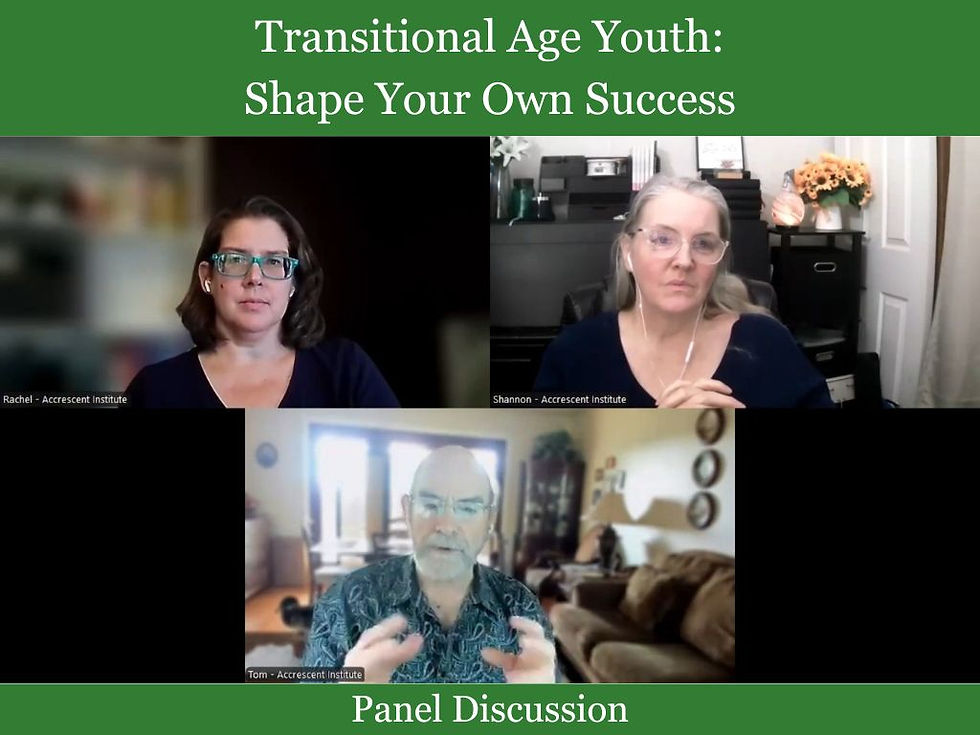
In this 12 minute video, Accrescent Institute founder Thomas C. Rector shares how a tool called The Agreement Process facilitates conversation between you and the adults in your life.
Anchored in BioSocial Cognition, this tool helps all youth express goals safely and effectively. By shifting communication into a neutral, visually shared space, teens can ensure your voices are genuinely heard and respected.
This conversation presents:
A process that focuses on you presenting your ideas, goals, and plans first before adults offer feedback.
Shifting conversations onto neutral, shared written media so adults listen actively without immediately judging or interrupting.
Using structured questions to define your vision and ensure your message is accurately understood on your own terms.
Establishing safety and mutual trust when sharing personal goals with caregivers and adults in your life.
Communication Tool for Youth: The Agreement Process - Interview with Thomas C. Rector (Transcript)
Table of Contents
Taking the Lead: How Teens Use The Agreement Process
Shannon:
An important piece of the material that you share, particularly in The Agreement Process, is about communication. And communication is one of those lovely human skills that, as we grow older, we learn that we really need to improve our communication.
But as teens, we just wanna be heard. There's a lot of voices telling us what to do, and we have our own ideas as teens.
I know I certainly did, and I think that foster teens in particular have a lot of voices telling them what to do or how they need to do it. I don't think, I know that that's the case.
So can you speak to how the trainings helps teens and young adults improve their communication and what The Agreement Process does for them?
Thomas C. Rector:
So let's talk about communication. What is communication?
It is a two-way street. It's not a one-way delivery, it's a two-way street.
You've gotta be able to articulate to somebody else, and the somebody else has to be able to hear, to understand what you are articulating. And there are so many hiccups in that particular process that occur because a word can mean two different things.
English words have multiple meanings. When you look 'em up in the dictionary, they'll give you three or four or six or 10 different meanings for a particular word.
And so part of the communication success is being literally aware that what I am saying doesn't necessarily mean what they're listening and hearing.
To be successful at communication, it isn't just about speaking our viewpoint, it is speaking our viewpoint in their language.
Yes, it's English, but it's gotta be their English, their experience.
So when we do The Agreement Process, it is set up in such a manner that the miscommunication that can happen, because this word means something different than what you intended to the other party, is the opportunity to be discussed.
So the fundamental part of that is not to rely upon only verbal communication, but to reinforce that, back that up with written communication.
And the reinforcement of that is that this written communication is on a piece of paper that both people can see, and so neither party owns what's written, and both parties get to see and translate and discuss what's written.
There's many studies that's been done with regard to how much do we hear when somebody's talking? How much do we retain through that? It's a very low percentage, and it gets lower and lower with a little bit of time. And so The Agreement Process is created to fill in these spaces of weakness that can happen in communication.
Putting Youth Ideas First: How The Agreement Process Works
The other part of it is the communication is set up to have a very intentional take turns presenting, presenting communication. And it starts with: the youth gets to talk first.
And there is a list of things that it starts off with, "What would you like? Let's just name what you would like, whatever it is."
And then you go into the who, how, when, where, what: how much does it cost? how are you gonna accomplish it? Those kinds of questions. They're very basic, very simple, but it's set up so that the youth's voice is first.
And the “rules of engagement” that we propose and we, we say you should follow is the adult just writes down what you said, and they don't comment on it. They just write down what you said, and you go down and you list all these different things that you have.
So there's an opportunity, the process gives the opportunity, to allow the youth to put their whole idea, their whole plan, down first - before the adult person is then questioning, or asking, or clarifying, or whatever it is.
That's unique. That's totally unique. And it's done in writing so that it's easy to be able to go back and, "What, well, what did you mean on this word," or, "What was this idea?"
The second part is then the adult gets to ask “clarifying questions”, not to poke holes, not to put down, not to second-guess, not to put in other ideas, but just literally understand what the communication you as a teen was putting forth.
That kind of process reinforces and supports the goal of communication, which is I want to tell you this, I want you to understand what I'm telling you, and that we can have a discussion of what that means.
So interesting enough, I've presented this many times, and multiple times there has been individuals in the group who have said, and usually it's a wife, which is, "Oh, I'm gonna take this back to my husband because we could work on our communication using this particular tool."
It hasn't always been that way, but it's just like, yeah, it works. It works. It's, it's a very, very solid system.
Creating Safe Spaces for Youth Voice
Shannon:
The concern that comes up is, “Is it safe?”. Your experience at this point hasn't been, it hasn't been safe to share your ideas, necessarily, with the adults in your life.
And how can we trust that doing The Agreement Process with an adult is going to be safe, that they are going to listen, that they're not gonna use it against you, or react badly to it?
How do we address that concern?
Thomas C. Rector:
Yeah. And, and that's truly a concern. I mean, absolutely a concern. For the process to work, there has to be agreement that we're gonna try the process.
There has to be an agreement we're gonna try the process. And so there is training a lot, many times, training that is for the adult version of this conversation is “What are the ‘rules of engagement’? What do you have to do to allow this to be something that works?”
So I've had a few teens, I can think of one specifically. It was probably, I don't know, 10 or 15 years ago, and I was speaking to Spanish-speaking youth. There was a particular young man that was, I don't know, probably 15, 16 years old. A young man in there and he, I was told on the sidebar, that there was challenges at home right at the moment. He was very quiet. He was absolutely very quiet and [the training] was about The Agreement Process.
When we were all done with the presentation and the training, which was multiple times, then they did a, not a potluck, but a food thing. So everybody, all the youth were out at the food table, and we were outside, and there was picnic tables.
I went up and sat next to this young man and I said, "So did you get anything out of this?"
And he said, "Yeah. I shared this with my parents, and it worked. I did my part, they did their part, and it worked."
I commented about this later on with one of the supervisors that was there the next day or whatever it was, and they said, "Yeah. Yeah, he took it home. He shared what he'd learned in this training, and they engaged in his ask to do this particular process, and it worked."
I talk to the same people or work with the same people year after year after year, right? And so the following year when I was doing a training, I said, "How'd the young man do?" "Oh, it's working really well."
So I think that the parents, I think that the adults so many times are also looking for a way of making the communication work and just being able to have the youth bring this back home, or back to wherever, and say, "I learned this, and this is how this works, and I would like to try this,"
I think that you'll find many of the adults will engage simply because they want communication to work, too.
They want it to work. They're there to help the youth. Not all of them, I'm sure, but that's a great starting place. And the youth are able to say, "If you go onto this website and go to click on this particular spot in it, then you'll get training on it or you'll have the understanding of how it works, too." So they don't have to deliver the whole thing.
Building Equal Ownership with Visual Communication Tools
What's really important, really important is that it starts with the form, the easel-size form. To do it off a little eight and a half by 11 is compromising the process tremendously. The reason for that is because if you do an eight and a half by 11 piece of paper, then one person owns that.
The Agreement is not one person owns that. The Agreement is the parties own that. So by doing the larger piece of paper, the parties own that, and the parties can see it equally, and respond, and engage in that particular part of it.
It's interesting that it makes that much difference, but it does. It makes that much difference.
Shannon:
So instead of, “I'm communicating to you.” it’s “We are communicating together.”
Thomas C. Rector:
Correct. Correct.
Learn more about The Agreement Process, trainings where it's introduced, easel size forms, or to access our on-demand training:
Interested in exploring more discussions and practical tools designed for navigating life during and after the foster system? Additional resources are available here:
Foster Youth / Transitional Age Youth
Learn More about Training for:


Comments