
Youth: Leveraging the Opportunity of "I Don't Know"

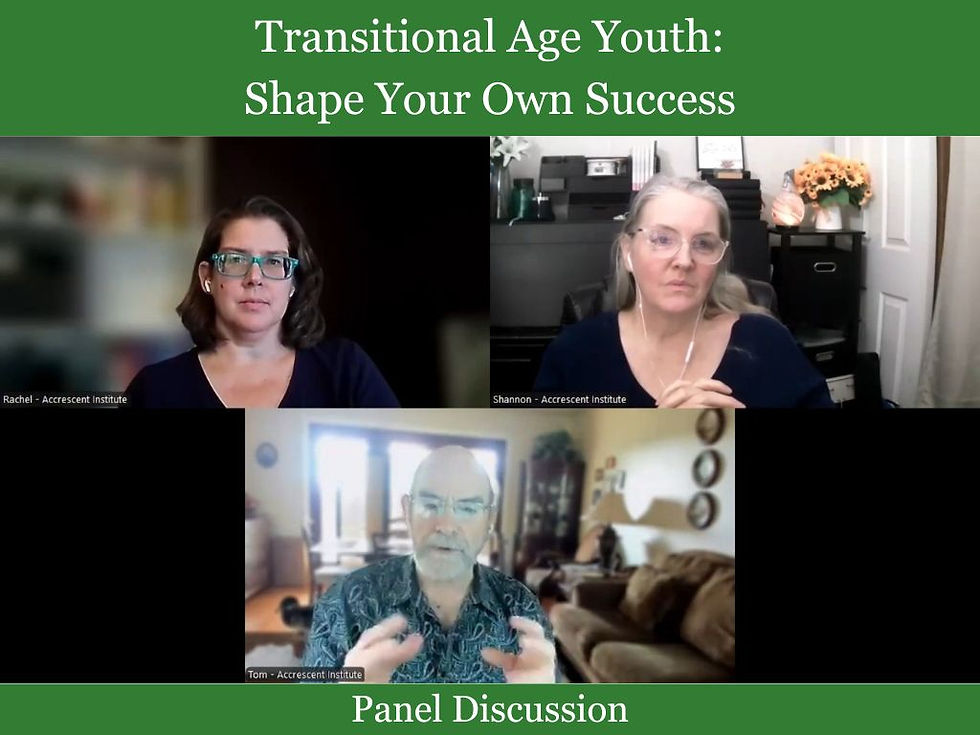
In this 11 minute video specifically for Teens and Young Adults, Thomas C. Rector discusses the empowerment that comes with understanding that your desire to make your own choices isn't just about independence --- it is a physical, biological milestone of brain development. Tom also explains why a lack of experience is not a personal failure or deficiency; it is a natural biological starting point and an invitation to gather valuable information.
Listen in to learn a few of the principles Tom teaches in Your Brain, Your Choice to help you more smoothly navigate the transition to adulthood, including:
Why do I feel so strongly about make my own decisions right now?
How can I get the adults in my life to respect my choices and independence?
What is the best way to choose mentors who actually support my goals?
How is "I don't know" an opportunity - not a weakness?
Youth: Leveraging the Opportunity of "I Don't Know" - Your Brain, Your Choice - Interview with Thomas C. Rector (Transcript)
Table of Contents
Understanding the Biological Shift Toward Teen Autonomy and Personal Choice
Shannon:
Let's start with the idea of choice. Your Brain, Your Choice is the session that is specifically for teens and young adults.
You have very specific wording with that. As far as, “Your Brain, Your Choice”, what does that mean for you? What does that mean for the people, the teens and young adults who take that training?
Thomas C. Rector:
I think that what's really important for us, us adults and our youth, is that we are an individual.
That we understand that we get to decide what we are going to do. I, as a person get to do.
As a youth growing up in the early years of our youth-hood, we are not qualified to make a lot of decisions because our brain has not developed to a particular point that is able to intellectually know and process, and it doesn't hold the memories of life experiences that's accumulated with time.
But when we reach a particular brain development stage, the brain now gives the ability to the person to recognize themselves as an individual.
And within that, they are then able to make, or want to make - really, truly driven biologically to make - their own decisions.
And so the emphasis that I like for us all to hear is it's, “it's my brain and it's my choice.”
The empowerment, the validation for each of us individually is defining as to how we understand our role, our responsibilities, and how we understand taking information in from the outside world. 'Cause there's lots and lots and lots of information out there for us to learn and be able to use as we go forward.
The training, the information, that is presented within this particular training presentation is that we can see that it isn't just words, “My brain, my choice”. It is truly, factually, biologically your own brain.
It works in a particular way, it develops in a particular fashion, and it brings us to this place where we can make our own choices.
How are those choices being made is really, really important for each of us to understand so that we can use that information to make choices that are productive and make sense in our world, make sense in the world that we stand in.
So the brain is the individual part of it.
The choice part of it is being able to truly understand, “I have five senses I'm taking information in. This information is being run through a system, the brain. It is arriving at recommendations of what kind of response we're gonna make to that.”
So it's our brain, it's our choices, and it's also our responsibility. The more we know and understand that process, the more successful we will be in making those choices.
How Teens Can Build Productive Conversations with Parents and Mentors
Shannon:
I had an actual physical reaction as you were setting that up, as far as being unqualified to make choices for myself and I know that as a younger person, as a teen, I really also, like, being told I am unqualified or I don't have power to make my own choices does not set well for me, and that's part of me as an individual.
But when we were talking about … a lot of teens, whether they be foster teens or not, and young adults, there's a lot of adults in their lives not yet willing to let them have that choice. How does what you train equip them to handle that?
Thomas C. Rector:
First. We divided it in a couple parts.
First of all is the better we understand ourselves and better we understand how we work, and the better we understand why we respond a particular way, the more control we have, the more personal choice we have as to how we're going to respond to that particular environment.
Once we have, or achieve, that understanding of ourselves, then that can be projected to the adult that's in front of us.
They're doing the same thing. They've got their brain, they're making their choices. They're using their particular memories to make those particular choices. And the better we understand where they're coming from, the easier it is for us to engage and have a communication.
And, as a teen, it allows us then to see what they don't understand or don't have knowledge of, and how can we, as a teen, be able to fill that space in, bring new information in, and how do we bring that information in so that it's not pushing buttons, but it is adding to resources.
So it's a circular kind of conversation. We start with ourselves. And we understand ourselves. Because of how we understand ourselves, we can use that to help project how to understand those around us.
The challenge for us as teens - and we all get to be teens - the challenge is that we get the ability, we get the biological drive to make our own decisions before we get the information to use to do those decisions.
And so the challenge is for the teen to, one, understand that it's not a deficiency or a lacking of. It's an opportunity to be able to recognize, “oh gosh, I haven't done this experience before and I have the opportunity to engage that experience - own those memories, own my own memories” rather than just doing what I've been told to do.
And when we understand that, then we're able to look at “lack of knowing” as an opportunity and “lack of knowing” being a purposeful - fill that space in - kind of experience.
We don't have to just forge through it. We can do that. Then that makes the value of the mentor, the value of the elder look different. Yeah. They know something. They're giving me advice.
It's now no longer telling me, it's me absorbing knowledge that I am going to make my own choices with.
But it's a circular thing. We first get the ability and the biological drive to make our own decisions. We acquire the information to be able to fill in that and support that desire, that biological drive. It's spinning. It's spinning.
How Successful Leaders Use Mentors to Make Informed Decisions
Shannon:
New thought that just popped into my head as you were talking about that is also, the component of choice and understanding the material, is also that you have the choice of your mentors and when you understand more of the information, and more of other people, then you can make more informed choices for mentors that support you and the direction you want to go.
Thomas C. Rector:
Correct.
Shannon:
So I don't think I processed that before.
Thomas C. Rector:
If you move this forward, you take this concept and you move it forward into the world of adults and business and stuff, the successful leaders in the world, whatever that niche that they're in, those successful leaders have cultivated, intentionally cultivated individuals that they will go to and ask a question and listen to their input.
And there'll be multiple different ones that they will do - some are in one particular topic, some are in another topic, some are another topic.
But those leaders have recognized that they don't know, and there's different perspectives and that if they find a person, or persons, that have that kind of knowledge or some perspective of that particular knowledge, they will access that person as a mentor and add it to their own pool of knowledge and then make their own choice.
They don't do what they're told. They're just getting more informed and more educated so they can do that.
Informed Decision Making and the Opportunity of "I Don't Know"
At our teen development stage where the brain now gives us the ability to make our own decisions, and is prompting us to make our own decisions, when we understand what's going on, we have the opportunity to really develop that methodology.
To fill in the knowledge, fill in the perspective, experience through other people's experiences so we can use that to make our decisions.
It's really a huge opportunity. It's also getting comfortable with ourselves, because
“I don't know” does not make me less.
“I don't know” gives me an opportunity to grow.
That's a really important perspective of ourselves.
We invite you to learn more about our training designed specifically for youth, teens, and young adults:
Additional Resources:

Comments